
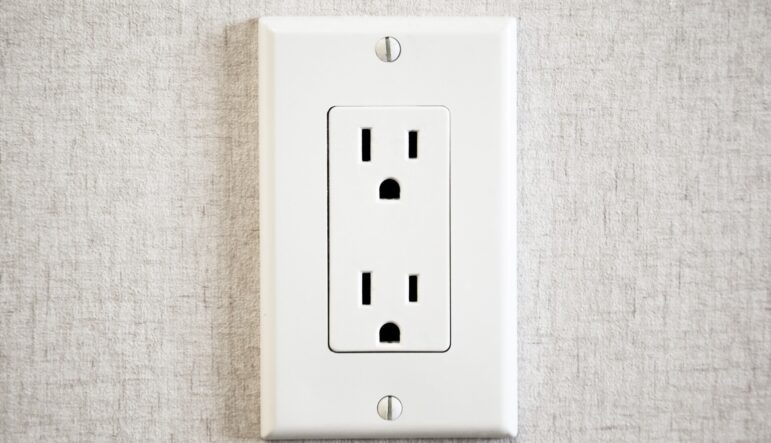
It is not about how many plugs fit into the wall, it is about how much electrical load the circuit behind that outlet can safely handle. Every outlet is connected to a branch circuit protected by a breaker, and that breaker determines how much power you can safely draw at one time. Understanding a few simple rules can help prevent overloaded circuits, tripped breakers, and potential fire hazards.
Most residential outlets in the United States are connected to 15-amp or 20-amp branch circuits [1]. A standard 15-amp circuit operating at 120 volts has a theoretical maximum of 1,800 watts. A 20-amp circuit can handle up to 2,400 watts.
Electrical safety standards limit how much of that capacity should be used for continuous loads. The widely recognized 80% rule for continuous loads [2] limits a 15-amp circuit to about 1,440 watts and a 20-amp circuit to about 1,920 watts when devices run for extended periods. This safety buffer reduces overheating risk and protects wiring insulation over time.
It is also important to understand the difference between receptacle rating vs. branch circuit rating [3]. The outlet itself may be rated for 15 or 20 amps, but the breaker protecting the circuit ultimately determines safe capacity.
The safest way to determine how many devices can share one outlet is to calculate total power demand. The formula is simple:
Most household outlets supply 120 volts. If a device lists amperage instead of wattage, multiply the amps by 120 to determine wattage.
A helpful planning guideline uses 1.5 amps per outlet for load planning [4], which equals about 180 watts per receptacle. This is a conservative estimate used for general circuit design. In real life, some devices draw far more power than others, so checking each appliance label is essential.
For example, several phone chargers and a laptop may total under 300 watts combined. Add a space heater, which commonly draws 1,500 watts, and the safe limit on a 15-amp circuit is nearly reached immediately.
Certain appliances demand so much electricity that they can consume most of a circuit’s safe capacity by themselves. A portable space heater drawing 1,500 watts [1] uses nearly the full continuous limit of a 15-amp circuit. Hair dryers, microwaves, coffee makers, and window air conditioners fall into the same high-demand category.
These types of appliances often require dedicated circuits for high-load appliances [5] to operate safely without competing with other devices. Plugging them into power strips or extension cords increases risk and should be avoided.
A common misconception is that adding a power strip increases available power, however it does not. It simply adds more plug space.
Overloading a strip or “daisy-chaining” multiple strips together [6] creates concentrated heat and increases fire risk. The dangers of daisy-chaining power strips include excessive resistance and overheating at the outlet connection point.
When an outlet is pushed beyond safe limits, you may notice overloaded outlet warning signs [7] such as warm wall plates, buzzing sounds, burning odors, flickering lights, or repeated breaker trips. These are signals that the circuit is under stress and should not be ignored.
Knowing how many devices can safely share one outlet requires understanding your breaker size, adding up wattage, and respecting the 80% safety buffer. It also means recognizing when high-demand appliances need their own circuit and avoiding shortcuts with extension cords or overloaded power strips.
If you are unsure which outlets share a circuit, need additional capacity, or want to upgrade your electrical panel, CoreTrade Electric can help. Contact CoreTrade Electric today to evaluate your electrical load, install dedicated circuits where needed, and ensure your home’s wiring is safe, efficient, and built for modern power demands.
Sources: